





Diamond Buying Guide: The 4Cs and Beyond
A diamond’s quality and price come from the 4Cs: cut, color, clarity and carat weight. Cut matters most for sparkle; color and clarity matter mainly to the point you can see them; carat drives price fastest. Add shape, certification, natural vs lab-grown, and a fifth C we care about most: cost you can see.
Cut, color, clarity and carat explained with real scales, how they change the price, shapes, fluorescence, certification, natural vs lab-grown, and every type of diamond we cover.
By Amit Jhalani, third-generation jeweler · Updated October 2026

| The 4Cs | Cut, color, clarity, carat |
|---|---|
| Color scale | D (colorless) to Z |
| Clarity scale | FL to I3 |
| 1 carat | 0.2 g; about 6.5 mm round |
| Sparkle comes from | Cut |
| Certified | Natural 0.75 ct+; lab above 1 ct |
| The 5th C | Cost, disclosed |
Cut: Where the Sparkle Comes From
Cut is how well a diamond’s facets are proportioned and finished, and it decides brightness, fire and sparkle. It is the C you notice first. GIA grades the cut of round brilliants from Excellent to Poor; other labs use Ideal at the top.
| Grade | What it means |
|---|---|
| Excellent / Ideal | Maximum brightness and fire; the best choice for value |
| Very Good | Bright, with small compromises most eyes can’t see |
| Good | Noticeably less sparkle |
| Fair / Poor | Light leaks out; looks dull |
Polish and symmetry describe the finish and how precisely the facets align; Excellent or Very Good on both is ideal.
Color: D to Z
White diamonds are graded by how little color they show, from D (colorless) to Z (light yellow or brown).
| Grades | Category | In a ring |
|---|---|---|
| D, E, F | Colorless | Icy white; the highest price |
| G, H | Near colorless | Looks white face-up; great value |
| I, J | Near colorless | Faint warmth; beautiful in yellow or rose gold |
| K–M | Faint | Visible warmth |
| N–Z | Very light to light | Clearly tinted |
Beyond Z are fancy colored diamonds. See our colored diamond guides.
Clarity: FL to I3
Clarity grades the tiny inclusions and blemishes inside and on a diamond, judged under 10x magnification.
| Grade | Meaning | To the naked eye |
|---|---|---|
| FL, IF | Flawless, internally flawless | Clean |
| VVS1, VVS2 | Very, very slightly included | Clean |
| VS1, VS2 | Very slightly included | Clean; VS2 is a value sweet spot |
| SI1, SI2 | Slightly included | Often clean (SI1); check SI2 |
| I1, I2, I3 | Included | Inclusions usually visible |
More in our clarity sweet-spot guide.
Carat: Weight, Not Size
One carat is 0.2 grams (100 points). Price rises faster than weight, and jumps at round numbers such as 0.50, 1.00 and 2.00 carats, so a 0.90 ct can look nearly the same as a 1.00 ct for noticeably less.
| Carat (round) | Approx. diameter |
|---|---|
| 0.25 ct | 4.1 mm |
| 0.50 ct | 5.1 mm |
| 0.75 ct | 5.8 mm |
| 1.00 ct | 6.5 mm |
| 1.50 ct | 7.4 mm |
| 2.00 ct | 8.1 mm |
Diameters are typical for a well-cut round; cut proportions change how large a diamond looks.
Shape
Round brilliant is the most popular and sparkles most. Oval, pear, marquise and radiant shapes look larger per carat and lengthen the finger; cushion is soft and romantic; princess is crisp and modern; emerald and asscher step cuts show clarity rather than sparkle. Fancy shapes often cost less per carat than rounds.
Fluorescence
Fluorescence is a glow, usually blue, that some diamonds show under ultraviolet light. According to GIA, about a quarter to a third of diamonds fluoresce, and only a small fraction strongly enough to affect appearance. Faint to medium fluorescence rarely matters and can even make lower-color diamonds look whiter; very strong fluorescence occasionally causes a hazy look.
Certification
A grading report from an independent lab confirms what you are buying. Every TrueSanity natural diamond of 0.75 carat and above is certified, and every lab-grown diamond above 1 carat comes with an IGI report. Check that the report matches the stone, and that its origin (natural or laboratory-grown) is stated.
Natural vs Lab-Grown
Lab-grown diamonds are real diamonds with the same 4Cs, at a fraction of the price; natural diamonds are rarer and hold value better. Both look identical without lab equipment. Read our full lab-grown diamond guide and the detailed comparison.
Colored and Specialty Diamonds
Diamonds come in every color. Explore our guides to black diamonds, blue diamonds, yellow and canary diamonds, champagne diamonds and salt and pepper diamonds.
The 5th C: Cost You Can See
Two diamonds with the same grades can carry very different prices, because the markup is hidden. We show it: every TrueSanity piece ships with a Transparency Manifest listing the metal, the stones, the craft, logistics and what we make. See a live example below.
Nocturnal Luxury, Radical Transparency
What a diamond piece really costs
The diamond is usually the biggest number on the bill, and the easiest to inflate. This is the live Transparency Manifest of a real diamond piece: metal, diamonds, craft, logistics, and what we make.
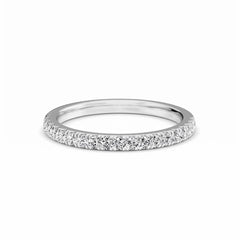
How the Transparency Manifest works →White Diamond Prong-Set Eternity Band - Rupal
Diamond FAQs
What are the 4Cs of diamonds?
Cut, color, clarity and carat weight, the system used to describe and grade a diamond's quality.
Which of the 4Cs is most important?
Cut, because it decides how much a diamond sparkles. A well-cut diamond with slightly lower color or clarity often looks better than a poorly cut one with higher grades.
What is a good color and clarity for a diamond?
G or H color and VS2 or SI1 clarity often look white and eye-clean in a ring, at a much better price than the top grades.
How big is a 1 carat diamond?
A well-cut 1 carat round diamond measures about 6.5 mm across. Carat is weight, so shape and cut change how large it looks.
Does fluorescence matter?
Usually not. Faint to medium fluorescence rarely affects appearance and can make lower-color diamonds look whiter; very strong fluorescence occasionally causes haziness.
Are lab-grown diamonds graded on the 4Cs?
Yes. Lab-grown diamonds are graded on the same 4Cs, and the report states their laboratory-grown origin.
Do TrueSanity diamonds come with certificates?
Every natural diamond of 0.75 carat and above is certified, and every lab-grown diamond above 1 carat comes with an IGI report.
What is the 5th C of diamonds?
Jewelers use it for different things. For us it is cost: every TrueSanity piece shows its metal, stone, craft and margin in a Transparency Manifest.
Keep Learning
More from the TrueSanity guides.
Find Your Diamond
More guides
Sources: GIA, the 4Cs · GIA, How to Buy a Diamond.
Clarity is a Form of Luxury.